

CONTENTS
RESEARCH AREAS
OCEANOGRAPHIC MEASUREMENTS
ATMOSPHERIC MEASUREMENTS
MARINE BIOLOGY
EQUIPMENT
PLANKTON SAMPLING
The PlanktoSpace program

Scientific leads: Colomban de Vargas (CNRS) and Emmanuel Boss (Univ. Maine)
The PERSEVERANCE actively participates in the international program PlanktoSpace, led by the ESA and in connection with NASA. This ambitious project aims to establish the largest standardized in situ database on oceanic planktonic biodiversity, in direct link with satellite ocean color data (PACE, Sentinel-2, Sentinel-3, OC-CCI missions). The PERSEVERANCE, as a mobile, agile, and autonomous research sailing vessel, represents an ideal platform for this type of collection.
In this context, a spectrofluorometer designed by Professor Emmanuel Boss (University of Maine), a specialist in marine bio-optics and co-lead of PlanktoSpace WP2, was installed aboard the PERSEVERANCE during the United Nations Ocean Conference (UNOC) in Nice in June 2025. This high-precision instrument allows for the measurement of the optical properties of seawater, particularly fluorescent signals related to phytoplankton. It has been successfully tested and will remain on board for the duration of the program. The collected data will be transmitted in real time via the ship’s satellite connectivity to contribute to the calibration of space observations and the development of machine learning algorithms capable of linking the biotic composition of marine ecosystems to their optical signature detected from space. This partnership places the PERSEVERANCE at the heart of a new generation of global scientific effort, directly linked to climate and biodiversity issues.
This program is supported by:
 The PlanktoSpace project involves a participatory science program “Plankton Planet : Understanding the biodiversity and evolution of the ocean microbiome through participatory science”
The Plankton Planet program

Scientific leads: Noan Le Bescot and Colomban de Vargas (CNRS – SU)
Initiated in 2015, this participatory science program aims to awaken the curiosity of “citizens of the seas” and nurture the creativity of a new generation of researchers in global ecology. Its central objective is to deepen our understanding of the biodiversity and evolution of the ocean microbiome, while prioritizing a collaborative and sustainable approach.
In 2023, Noan Le Bescot participated in an expedition to the Antarctic Peninsula to test data collection aboard the PERSEVERANCE for this project. A specific protocol adapted to the characteristics of the Perseverance, such as its speed, drift, and accessibility, was developed. Following a conclusive experiment, a long-term collaboration was agreed upon.
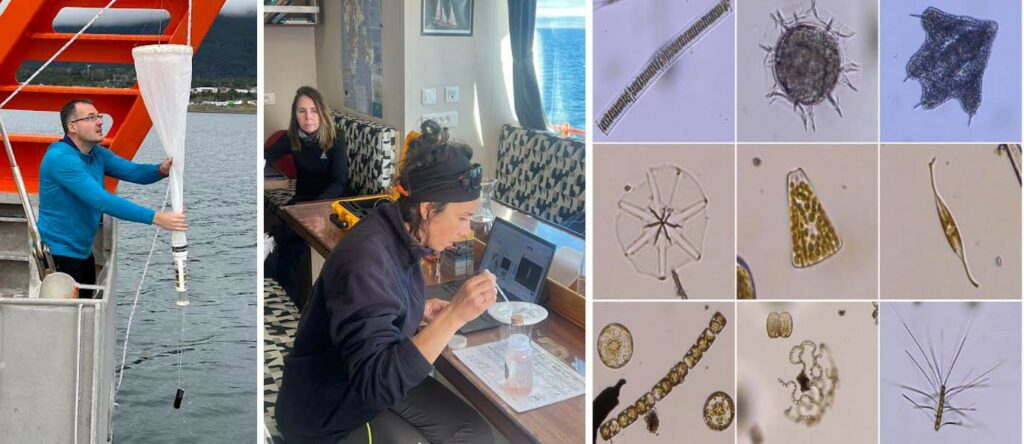
Noan Le Bescot on the aft deck for sampling (left), Marion Fourquez in the saloon for observation (middle), and plankton observed during the Antarctic expedition (from the Plankton Planet website, right).

