

CONTENTS
RESEARCH AREAS
OCEANOGRAPHIC MEASUREMENTS
ATMOSPHERIC MEASUREMENTS
MARINE BIOLOGY
EQUIPMENT
Supported Programs
Oceanography
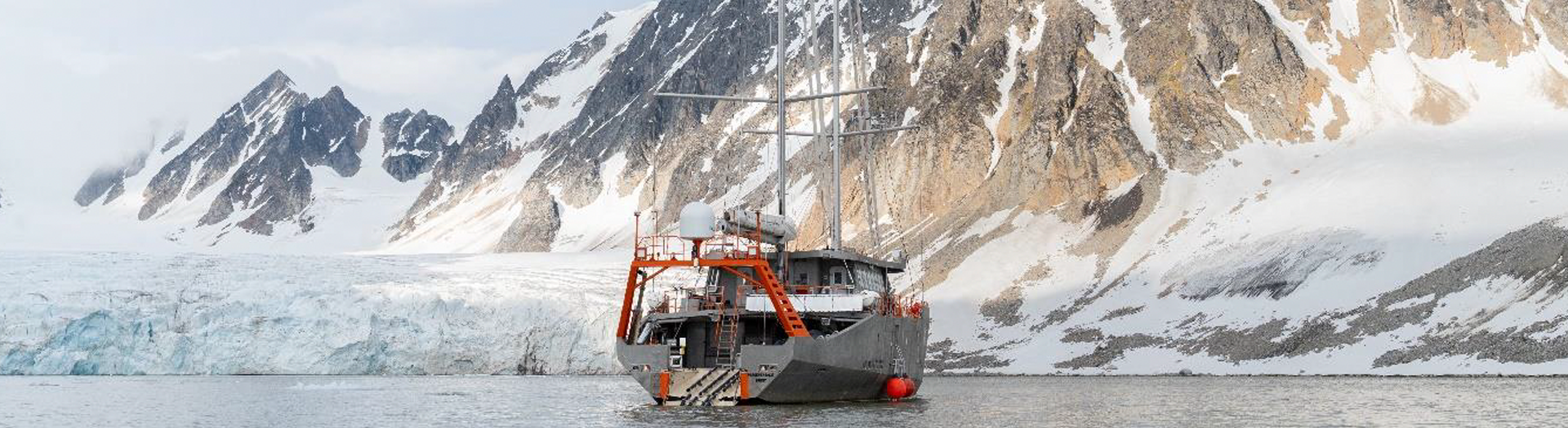
The National Sea Surface Salinity Observation Service (SNO SSS), coordinated by LEGOS (OMP, Toulouse) with support from IRD, relies on the sailboat’s campaigns to monitor ocean salinity, a key climate parameter. In partnership with Oceano Vox and Ifremer, data are also collected on ocean currents and their evolution. Furthermore, as part of the PlanktoSpace program (ESA – NASA – CNRS – University of Maine), optical measurements taken at sea enable the calibration of satellite observations.
Biodiversity
The participatory program Plankton Planet (CNRS – Sorbonne University) relies on the sailboat to collect data on the richness and evolution of the oceanic microbiome, involving both scientists and citizens. The sailboat has also enabled bioacoustics missions conducted by CNRS and the University of Toulon to listen to and census marine mammals in Svalbard.
Pollutants
Under the responsibility of the Institut de Physique du Globe de Paris (IPGP), the vessel measures concentrations of atmospheric pollutants such as mercury, ozone, and nitrogen oxides. In the ocean, a device developed by Ifremer and IRD enables the detection of dissolved mercury and micropollutants, even in polar regions.
Atmospheric Measurements
A photometer developed by the CNRS and the University of Lille, integrated into the international AERONET network coordinated by NASA, makes it possible to monitor aerosols. Innovative projects complement these measurements: CosmicSail (Astrolabe Expedition) detects cosmic particles.
Permanent Instruments
Atmospheric Measurements
The vessel is equipped with a Mercury meteorological station (Météo France) that continuously measures:
air and sea temperature;
atmospheric pressure;
relative humidity;
wind speed and direction;
cloudiness and other standard variables.
This data is transmitted to meteorological centers in near real-time (VOS – Voluntary Observing Ship) to enrich analyses and forecasts, and to calibrate satellites. It is also used to interpret oceanographic and atmospheric measurements in their context.
Oceanographic Measurements
Thanks to an Acoustic Doppler Current Profiler (ADCP), it is possible to capture the speed and direction of water masses in the water column, revealing underlying circulation, fronts, eddies, and the complexity of flows in the first few hundred meters.
A Ferrybox continuously measures the fundamental characteristics of surface water:
– temperature and salinity, which control water density and thus circulation;
– dissolved CO₂ and pH, markers of air-sea exchanges and acidification;
– dissolved oxygen, reflecting the biological health of waters and their ventilation;
– turbidity, an indicator of suspended particles and organic matter.
These continuous measurements trace the biogeochemical signature of the water masses traversed and allow for near real-time monitoring of these variables. Spot samples are taken using Niskin bottles and an oceanographic winch. Vertical profiles of temperature, salinity, and pressure are simultaneously performed using a CTD.

