

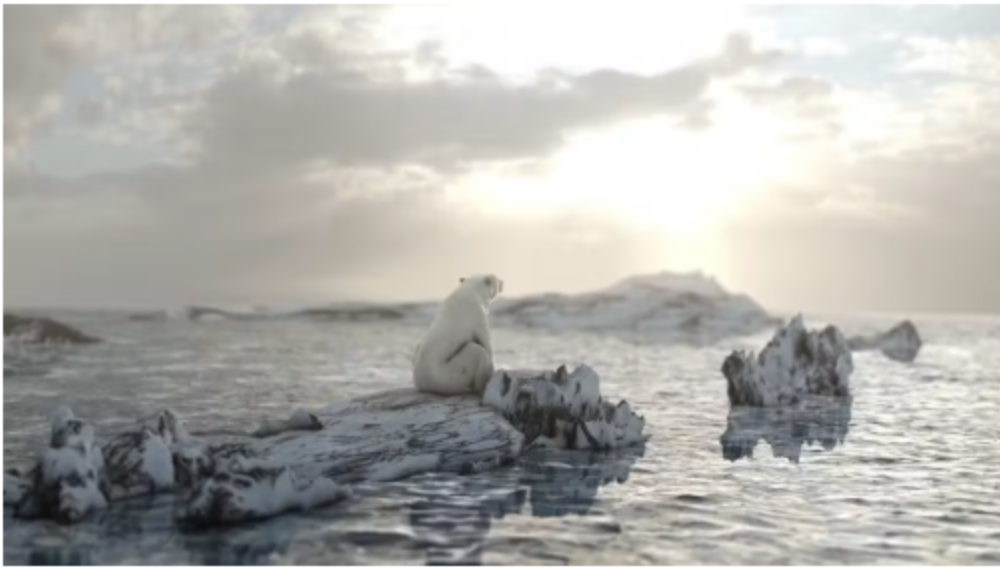
By losing its whiteness, the Arctic absorbs more heat and weakens the climatic balance of the Northern Hemisphere.
In this op-ed, explorer Jean-Louis Étienne warns about the runaway warming of the Arctic, which is heating up four times faster than the rest of the planet. As snow and ice melt, they weaken the albedo effect, disrupting even our weather patterns and making the massive reduction of CO₂ emissions even more urgent.
The Arctic, the cold pole of the Northern Hemisphere, is warming four times faster than the rest of the planet. The main reason? It is changing color. As it melts, the snow and ice lose their albedo effect, the capacity of white to reflect solar radiation.
This phenomenon, called the “Arctic Amplification Effect,” accelerates global warming and severely disrupts weather in our latitudes:
- Late cold snaps in spring: warm air rising northward displaces the Jet Stream and the polar vortex, propelling masses of glacial air, frost, and snow southward in the middle of April.
- Extreme heatwaves in summer: Arctic Amplification directly increases the frequency and intensity of continental heatwaves (IPCC Report, August 2021).
We are destroying the “Cold Factory”
If we do not act, temperatures could exceed 50 °C in the second half of the century. There is no other choice but to commit massively to achieving carbon neutrality by 2050. Our CO2 emissions must no longer exceed what nature is capable of absorbing.
It is possible, and each of us bears a share of responsibility: personal, professional, political.
It starts today.
Key Takeaways
A strong idea
The Arctic is the Northern Hemisphere’s cold factory. By losing its snow and ice, it loses its reflective power and warms four times faster than the rest of the planet, with consequences far beyond the Arctic Circle.
An urgency
To curb Arctic amplification, which disrupts major climatic balances and contributes to increasing extreme events in our latitudes.
A course of action
Massively reduce our emissions to achieve carbon neutrality, engaging all levels of responsibility: individual, professional, and political.
Sources
By Jean-Louis Étienne, physician, explorer, specialist in nutrition and sports biology, he has participated in numerous expeditions in the Himalayas, Greenland, and Patagonia. In 1986, he became the first man to reach the North Pole solo, after 63 days of walking on the ice floe. In 1989-1990, he participated in the TransAntarctica, the first complete crossing of Antarctica by dog sled, covering 6,300 kilometers. For several decades, he has dedicated his expeditions to understanding and protecting the polar regions and their role in the global climate. A member of the Academy of Technologies, he initiated the scientific project Polar POD, designed to study the Southern Ocean.

