

Approximately 32,000 species of fish roam the oceans, of which only 300 live south of the Antarctic Convergence (60°S). While species that live at great depths occupy immense underwater regions all around the planet – because their ecological niche remains the same – species that rarely stray far from continental slopes (a few hundred meters deep) are highly endemic, benefiting from particular ecosystems at the edges of islands and the continent.
BONY FISH
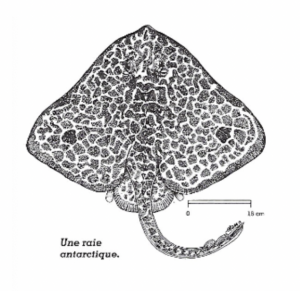
Bony fish (Osteichthyes) from the Antarctic and subantarctic regions, by far the most abundant, are small in size (nearly half measure less than 25 cm, although Dissostichus eleginoides exceeds 2 m). Their growth is slower than that of the cold-water species of the north and their sexual maturity is late (often more than five years).
Notothenias Notothenia are the most common fish (two-thirds of the species), followed by Channichthys, or icefish. The former (calandrians, Patagonian toothfish, and scallops) are mostly sedentary and demersal (which, in fishing terms, means living near the seabed, along continental margins). Some species are particularly adapted to life in water close to the freezing point of seawater (around -2°C): their bodies produce a natural antifreeze. Channichthys, as well as related species in the same family, which have scaleless bodies, possess the unique characteristic among vertebrates of having blood lacking hemoglobin. All of these fish are unknown in the Northern Hemisphere.
CARTILAGIOUS SPECIES
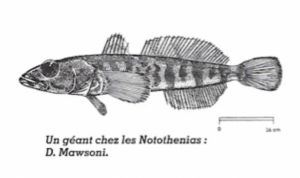
A few cartilaginous species (Chondrichthyes) also live in these cold waters. Sharks, uncommon here, are represented by only five bottom-dwelling species. Rays, of which there are four species, are frequent and constitute a significant portion of the Antarctic fish population.
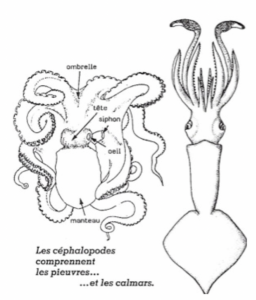
Besides fish, pelagic and benthic cephalopods represent a significant portion of the Southern Ocean biomass, and their dominant role in the food web of these regions is now recognized.
They are still only partially cataloged. The two main orders are squid (fusiform body ending in two fins and a mouth surrounded by ten sucker-like arms, including two tentacles, sometimes very long, used to capture prey) and octopuses (round, compact body with eight arms partially connected by a membrane, the bell).
In the waters surrounding Tierra del Fuego, the archipelago at the extreme south of America, a crustacean is particularly abundant: the “king crab” or centolla, actually a lithode, closer to hermit crabs (Anomura) than to true crabs (Brachyura).
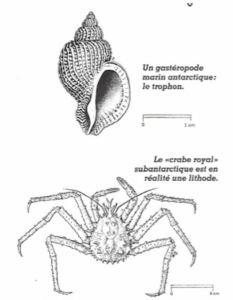
On the Antarctic seabed, around 100 species of bivalves, out of the 10,000 known species, have been recorded, along with 350 species of gastropods, out of the 20,000 known marine species. Mollusks, echinoderms, sponges, cnidarians, and crustaceans (isopods, amphipods, and lithodes, but no crabs) have colonized the Antarctic seabed. This benthic fauna is particularly abundant under the sea ice (enriching terrigenous inputs), although the shallow waters (less than 15 meters) are periodically scoured by floating ice.
FOR MORE DETAILS
Books
- Pour la Science n° 111
- Livre de Greenpeace (May)
- Grand Atlas Universalis de la Mer
- Fiches FAO (Hureau)

