

THE ARCTIC OCEAN AND ITS UNIQUE MARINE LIFE
Compared to the other oceans on our planet, the Arctic Ocean is species-poor. Most marine life – from zooplankton to the creatures that inhabit the sea bed – is endemic, meaning that it is typical of the region. This Arctic fauna, which sometimes ventures into the Norwegian Sea but never far into the Bering Strait, is precious and must be protected.
FROM ALGAE TO POLAR BEARS: THE ARCTIC FOOD CHAIN
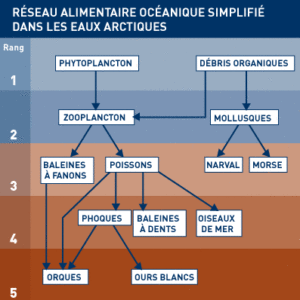
Even right next to the ice pack, algae (phytoplankton) grows and the creatures that comprise zooplankton (copepods, etc.) come to graze on it. The zooplankton attracts the small fish that feed on it and that are prey for sea birds, cetaceans and seals. These, in turn, are hunted – sometimes as far as the North Pole itself – by polar bears, which are followed by carrion eating birds who feed on the “left-overs”.
MARINE “FERTILIZERS” CARRIED ALONG BY THE CURRENTS
Ocean currents favour the growth of the life forms at the lower end of the food chain by carrying along the elements that are so essential to the growth of planktonic algae. But in the Arctic, the key factor in the food chain is the seasonal extension of the ice pack, which affects the supply of nutrients and light.
EVEN DURING THE LONG WINTER NIGHT, LIFE GOES ON
During the winter, plankton growth – which depends on photosynthesis – slows down very markedly, so larger marine life must find other sources of food, such as the organisms that have proliferated in summer, or various types of detritus. Some invertebrates even live by consuming reserves of body fat that they have built up during the summer. Other species that survive in winter include numerous bacteria as well as crustaceans, sponges and ice coral.
PRIMARY PRODUCTION IN THE OCEANS
Oceanographers estimate the amount of vegetal plankton (biomass) present at any given moment in an oceanic region by measuring the chlorophyll content of the seawater. The amount of vegetal biomass in the ocean, almost totally made up of microscopic algae, is a thousand times less than terrestrial biomass. On the other hand, phytoplankton multiplies very rapidly: just one diatom, with two cellular divisions every 24 hours, can generate a million descendants over a period of 10 days. Just compare this to a tree in a forest, which can sometimes take 100 years to reach maturity… Because of the rate at which planktonic algae multiply, primary production in the world’s oceans – calculated by measuring the carbon 14 absorbed by photosynthesis – can be similar to terrestrial biomass production: a hectare of ocean produces anything from 200 kg to nearly 2 metric tons of carbon each year, depending on the region, while a field of corn (maize) produces 2 metric tons of carbon per year.
THE RICHEST ZONES OF THE ARCTIC OCEAN: COASTAL ZONES AND ESTUARIES
During a month of May, scientists have observed 100 times more benthic amphipods under the surface of the coastal ice in northern Canada that on the seabed. In places where the sunlight penetrates as far as the seabed, production of plant matter – and therefore production of fauna as well – increases. When the thaw comes in spring, rivers wash down nutrients from inland areas, and ice melts more quickly in estuaries than elsewhere. So life persists just under the polar pack ice from one year to the next, despite the winter freeze-over – a fact that was long unknown to scientists.
Generally speaking, the biomass accounted for by the species that are closest to the top of the food chain (the vertebrates) is relatively small. Unfortunately for these animals, pollutants move up the food chain to concentrate in the ultimate predators (seabirds, seals, cetaceans, polar bears, etc.). This is visible in the traces of heavy metals generated by industrial activity (zinc, cadmium, mercury, selenium, etc) in the teeth of seals and the fur of polar bears.
POLYNYAS – OASES OF LIFE AT THE SURFACE OF A FROZEN OCEAN
Even in the middle of the polar ice pack, the wind and the ocean currents cause the sea ice to break up, leaving areas of open water – i.e. free of ice – called polynyas. These are the site of abundant marine life activity (plankton, fish, sea-birds, marine mammals).
Certain polynyas appear regularly in the same place. An example here is the Great Siberian Polynya in the Laptev Sea, in the midst of ice that lasts from early October until the end of June. Even in mid-winter, it stretches 200 kilometres and its open water allows seals and walruses to breathe and therefore stay there – together with their predators like polar bears and foxes. And in early spring, eiders, guillemots and long-tail ducks arrive in thousands to feed on fish and shellfish there.
A COMPLETE FOOD CHAIN WITHIN THE SEA ICE
Within the mass of sea ice itself, life forms subsist among the crystals of fresh-water ice and in the thin channels within seawater ice. A complete food chain can be found here, including planktonic algae (prasinophytes, dinoflagellates, chrysophytes, diatoms) and their decomposers (bacteria). Some of these organisms spend their whole life cycle inside the sea ice and others only part of their cycle, but all of them have adapted to a wide range of salinity and sunlight strength. This means that even during the Arctic winter, some algae can continue to photosynthesise using the very weak light of the polar night.
Some of these organisms originate in the sea and others are washed down to the sea by rivers. In winter, both their numbers and their species diversity are quite low, but as spoon as spring arrive numbers and diversity skyrocket, along with those of their predators. Then in autumn, when the sea starts to freeze over once more, they remain there, clinging to the ice. In sections of ice that have built up over several years, and thus several life cycles, the ice displays several strips or layers of microscopic communities that allow scientists to date successive spring “flowerings”.
COMMUNITIES OF LIFE ON THE SEA BED
TO FIND OUT MORE …
BIBLIOGRAPHY
- L’Arctique et l’environnement boréal, P. Avérous – CNDP, 1995
- L’Antarctique et l’environnement polaire (2) “EREBUS” ,P. Avérous – Dossier pédagogique – CNDP-1992
- Chercheurs sur l’Océan”, P.Avérous – Hachette – 1981
- Les missions de l’Antarctica : la traversée de Pacifique – 1994
- Arctic Flora and Fauna : status and conservation (CAFF, Conservations of Arctic Flora and Fauna, Helsinski Edita, 2001)
- Le feu sous les glaces – Sylvie Rouat, Sciences et Avenir – février 2002
- L’océan planétaire, Science et Avenir – 1994

